Escaping the Imaginations of the Elite: Care, Control, and World-Making Beyond the Carceral State
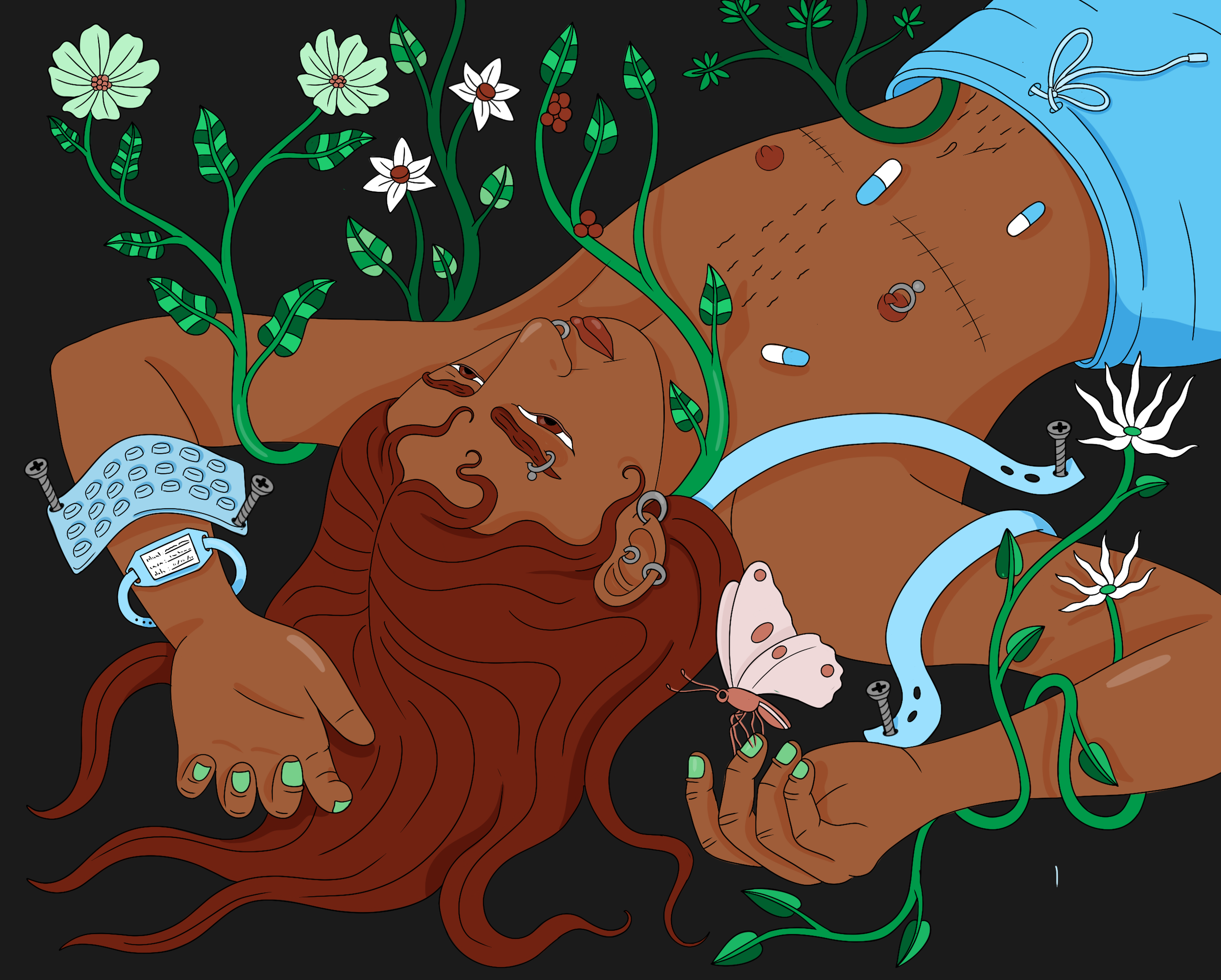
illustration by Lynne Zakhour
Abolition found me long before I found abolition, or rather before I knew it had a name, a practice, a community, a multiplicity of worlds, past, present, and future. As is so often the case, it wasn’t necessarily an easy or comfortable find. It didn’t appear in a burst of light or academic apophany, but rather, through sharp strip lighting, blister packs, whispering social workers, and the realisation that from a desperately young age, my one short life was grasped tightly in the imagination of others. A recognition that I was, to borrow from adrienne maree brown, in an “imagination battle” (2019: 10) with those that upheld the neoliberal banality of everyday healthcare, and consequently, my own imagination, be it in the light or dark, became an itching irritant to the ever-encroaching carceral creep.
Within this imagined world of the elite, locked doors and white coats became an everydayness. Trips to the GPs became trips to the psychiatrists, all under the label of care. Little was discussed about how we got here, why my pain, and increasingly my gender, were manifesting in ways that made others uncomfortable – an experience that has not necessarily dissipated in adulthood. Not that it bothered me much, I dropped out of school, and in between doctors’ trips found myself face to face with cops, with one authoritarian figure folding neatly into the other.
Whilst navigating this reality, I realised that my trans disabled body, held together by the love of a lone parent, was, in and across all institutions, silenced, dismissed, tied down, and controlled mentally, physically, and psychically. Consequently, I was an angry kid who became an angry adult, with the cycle continuing in one way or another to this day. The difference being that my anger now threads to the words of Audre Lorde and June Jordan, rather than vallum and the bottom of a vodka bottle.
Of course, my story is by no means unique, carcerality courts and consumes the psychiatric industrial complex, twin sibling to the prison industrial complex, their histories deeply intertwined (Ritchie 2023). Both intricate social structures are adept at disappearing those on the margins. The only tentative difference being that psychiatry has undergone a four-decade-long rebranding campaign strategically designed to shift its profile away from criminalisation to ‘care’.
And of course, this makes sense, the metamorphosis of control is very much in keeping with the ways of the coloniser. Prisons were born from the performative dismantling of the slave trade, made palatable again through policy changes, whilst the culture of capture remained unchanged (Gilmore 2022). This is a reality made clear by Sadiya Hartman, who stressed that neoliberal society is a prison nation functioning only because of the “afterlife of slavery” (2007:17). It is the glue that holds the state together, which is why, as we have learnt from Angela Davis, it feels impossible to imagine a world without the prison slaughterhouse (2011).
So, what does all this mean when it comes to care? Well, it means that our trust in it should be informed by who is administering such affection, attention, and safekeeping. This seems like an obvious reflection, until we take seriously that the carceral logic of the state has crept into our everyday understanding of care, exactly because it replicates the nexus of scarcity, surveillance, imprisonment and punishment that we have come to learn as acceptable in our society.
By result, carceral care is deeply rooted and all embracing, spanning from localised locked wards, reproductive violence, social services, and punitive welfare systems (Kim, Rasmussen & Washington Sr. 2024), to broader militarised care, such as interference, intrusion, and execution in the name of national security (Boodman 2020; Varma 2020), to humanitarian, bio-political and not-for-profit care, that bolster, support, and reproduce hierarchies that centre the normative body, and racialised, ablest, and heteronormative, notions of deservedness, often through surveillance and punishment (INCITE 2017). In her work on carceral progressivism, Savannah Shange notes that “racilized carceral logics [have] stretched beyond literal confinement to shape the practice of social justice movements” (2019: 15), and carceral care is one of the galvanising forces behind that. These power struggles are grounded in colonial structures that work to uphold Whiteness, and are fuelled by imperialism, racial capitalism, ableism, transphobia, heteropatriarchy, and all other constructs that deal in death.
Nonetheless, a large portion of my relationship with carceral care was co-dependent. Despite my consistent mistreatment in healthcare services, I simply couldn’t separate myself from them. In their expansive work on affective spaces and the emotions of belonging Lauren Berlant developed the concept of cruel optimism. That is, a condition “when something you desire is actually an obstacle to your own flourishing” (2020: 1). It was, it seemed, a condition of my psyche to continue to seek out carceral care, or more specifically presumed safety and protection, from institutions that continued to harm me, with the hope that perhaps this time it would be different. And of course, this makes sense, the mechanics of carceral care are strategically designed and weaponised to keep a person trapped in place and convinced (in one way or another) that this is the only space that will ever truly care for them, and as a result, disappear the most disenfranchised from society.
There were moments of clarity, of course, which I now understand to be abolitionist awakenings. These sprung from the spaces in between the moments of carceral care, small moments of empowerment and tentative hope that seemed to arise from non-compliance to the system, even when the system seemed to be the only thing holding me together. Hope from those who shared the same path as me, and a future beyond the controlling images that surrounded my trans disabled body (Hill Collins 2002). In her work on Abolition, Alexis Pauline Gumbs writes how “abolition is something that sprouts out of the wet places in our eyes, the broken places in our skin, the waiting places in our palms, the tremble holding in my mouth when I turn to you” (Gumbs 2008: 145). It was these very places that I discovered ecosystems of care that I never dreamt possible.
So, what’s the purpose of what can be understood as abolitionist care when it comes to escaping the imaginations of the elite? Well, abolitionist care lies in direct contrast to carcerality. Indeed, a significant portion of abolitionist care work is the unseen and too often ignored seminal labour of imagining, planning, and growing forth non-carceral care webs. Specifically, for those communities who are existing under the relentless eye of policing, medical interventions (be it an over- or under-abundance), surveillance, interpersonal and domestic violence, and other forms of violence embedded in the carceral state. Abolition care, then, is the very thing carcerality seeks to strip from us. That is, our creativity and generative imagination that allows for world-making and crafting better liberatory tomorrows, with joyous moments embedded in our journey to get there. As such, this care actively moves to diamante heteropatriarchal White supremacy and its embedded ableism and sanism, to create new pathways “outside the regimes of racial and gendered violence and normativity” (Hayley 2018: 9). In doing so, it embraces a landscape that actively resists the state, and within these spaces new mode of being can be established.
However, creating new worlds outside of the medical and psychiatric industrial complex is no mean feat; it takes significant reflective work, both individually and collectively, to unlearn the carceral and colonial rules of our reality. This is particularly true if you are White and thus have directly benefited from colonialism and the subordination of people of colour. Within this, we also need to kill the cop in our head, and recognise that so much of our existence, including how we both give and receive care, is built around policing each other, ourselves, our communities, and the natural world in which we inhabit.
So, where does this leave us in a time of ever-increasing violence against those in the margins, to which the medical and psychiatric industrial complex, and its deep-seated mechanisms of carcerality, play a crucial role? Here I turn to Ruha Benjamin, who in response to a question I asked back in 2020, and have held close since, told me, that liberation will never appear over night or in a pounding explosion (although pounding explosions may happen) but rather will flourish in the small and tireless connections that we make across groups, and how this desire for connection, in turn forges ecosystem. In these spaces of relation, we can support, uphold, and uplift one another, and beyond that, begin the process of dismantling and building anew on account of the mycelium that charges between us. This, of course, will take time, but that is not to say that we are not already enacting abolitionist care in our everyday lives, when we show up for each other, share food and medicine, create enclaves of safety, craft chosen family, hold each other through the storm, and much more besides. All these moments, these beats, are embodying care beyond the carceral, and should and must be celebrated as fugitive acts of refusal. It is here that we can and will forge pathways to liberation, on our own terms, holding the most vulnerable now, whilst keeping our eyes on the future.
Bibliography
Boodman, E. (2020). COVID-19, biopolitics and abolitionist care beyond security and containment. Abolition Journal.
brown, adrienne maree. (2019). Pleasure Activism. The Politics of Feeling Good. AKA Press.
Collins, P. H. (2002). Black feminist thought: Knowledge, consciousness, and the politics of empowerment. Routledge.
Davis, A. Y. (2011). Are prisons obsolete? Seven Stories Press.
Gilmore, R. W. (2022). Abolition geography: Essays towards liberation. Verso Books.
Gumbs, A. P. (2008). Freedom Seeds: Growing Abolition in Durham, North Carolina. Abolition Now Ten Years of Stratergy and Struggle Against the Prison Indurtrial Complex, AK Press.
Hartman, Saidiya. (2007). Lose Your Mother: A Journey along the Atlantic Slave Route. . New York: Farrah, Straus, and Giroux.
Haley, Sarah. 2018. “Abolition.” In Keywords for African American Studies, edited by Erica R. Edwards, Roderick A. Ferguson, and Jeffrey O.G. Ogbar, 9–14. New York: New York University Press.
INCITE!, Incite! Women of Color Against Violence, & Incite! Women of Color Against Violence Staff. (2007). The revolution will not be funded: Beyond the non-profit industrial complex. South End Press.
Kim, M., Rasmussen, C., & Washington, D. (n.d.). Abolition and Social Work Possibilities, Paradoxes, and the Practice of Community Care. Haymarket Books. (Original work published 2024)
Ritchie, A. (2023). Practicing New Worlds: Abolition and Emergent Strategies. AK Press.
Shange, S. (2020). Progressive dystopia: Abolition, antiblackness, and schooling in San Francisco. Duke University Press.
Varma, S. (2020). The occupied clinic: Militarism and care in Kashmir. Duke University Press.