I, Robot: My visit to the Leah Lakshmi Piepzna-Samarasinha retrospective at Tangled Arts
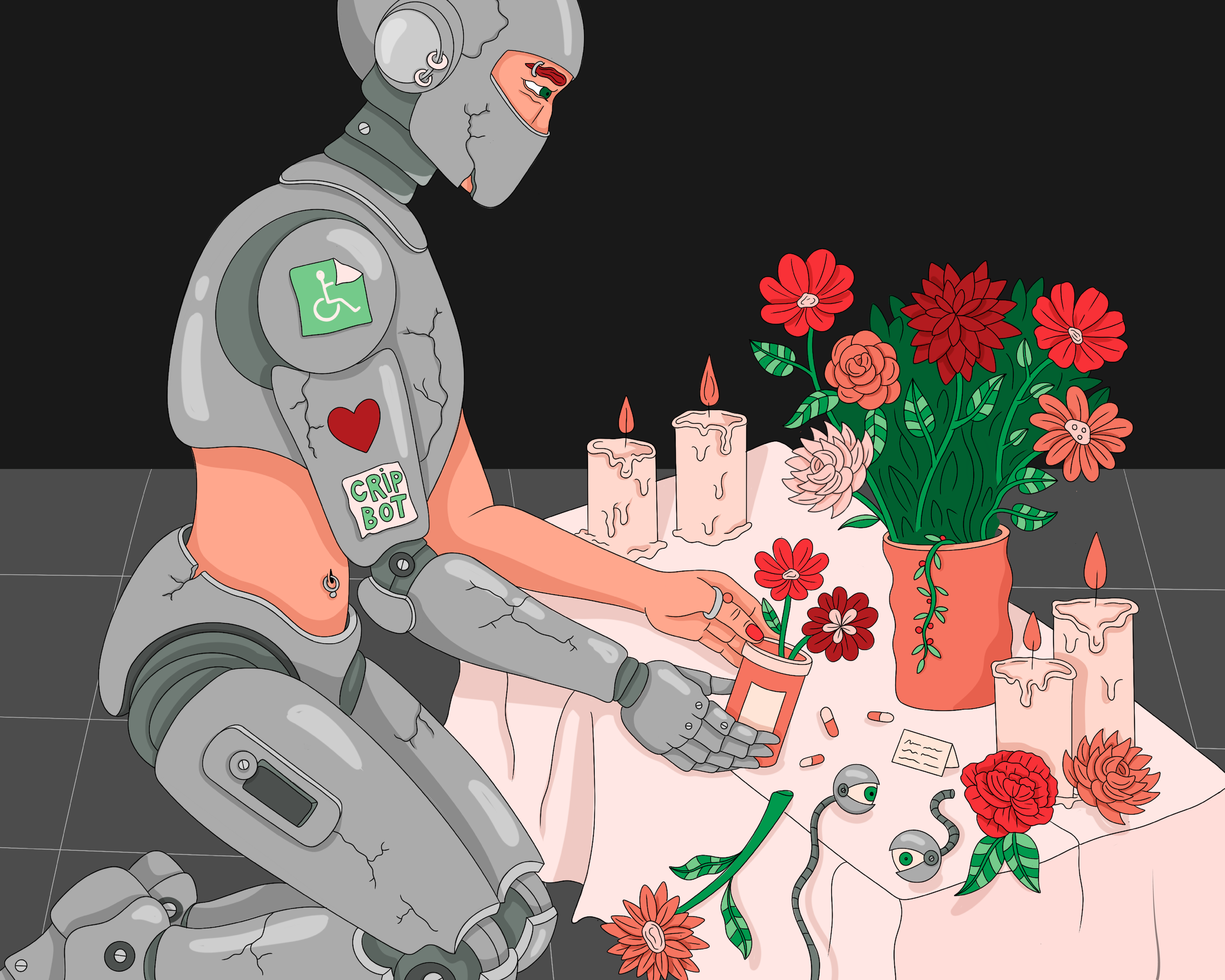
illustration by Lynne Zakhour
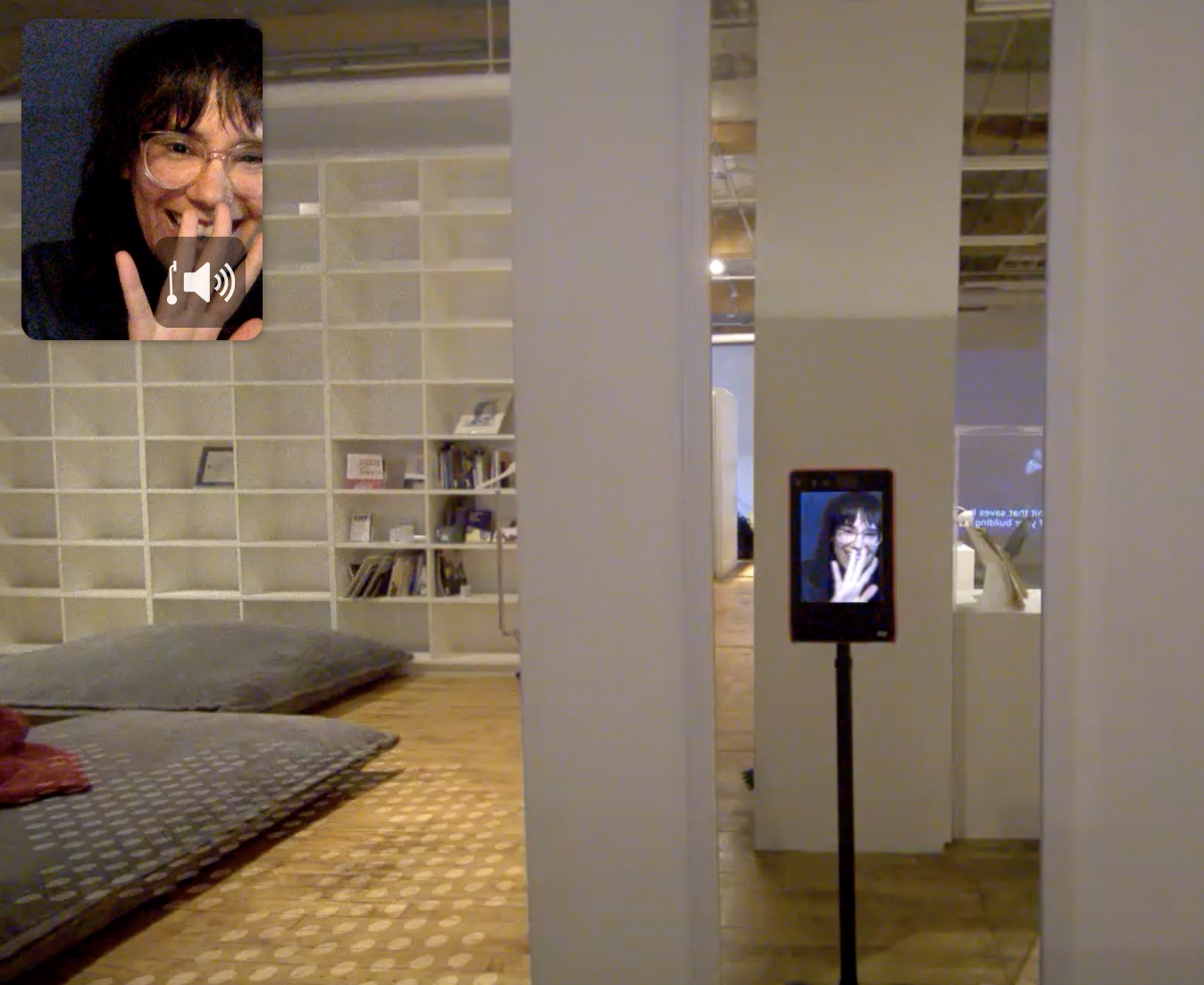
This witching season I crossed the veil not between the living and the dead but between UK and Canada, online and offline, to visit the Leah Lakshmi Piepzna-Samarasinha retrospective at Tangled Arts, Toronto. I was able to do so from the comfort of my home office in York, England, in the form of a robot. Rosa the Robot, to be precise, one of the gallery’s options for online visitors. When booking an online tour, visitors can choose to either be shown around by a staff member with a tablet on Zoom or to drive the gallery’s resident robot using their phone or laptop. With Rosa I could navigate the space, zoom in, and take screen shots, all with the wonderful Jet Coghlan (on site at Tangled) as my guide. This was my second time embodying Rosa and this time she was having some technical issues, which my natural tendency to fabulate could not resist. In my head Rosa became a kindred crip bot, with her own capacities and divergences, and it felt pretty apt to be at this event with/as her, given how integral Piepzna-Samarasinha’s work has been in my journey towards embracing and loving the capacities and divergences my own bodymind.
“I created this show as a chance to remember, and examine the ways my work has evolved from analog grassroots creativity in disabled brown isolation, to working collectively with other disabled QTBIPOC artists, to the now where we live in a fascist eugenic hellscape where the very nature of truth and memory is under attack, yet there is still rich disabled creative life and possibility.”
“This Body Keeps Me Up At Night" was, as they describe it, “a mid-career retrospective of disability justice writer, cultural worker and renowned hot bitch Leah Lakshmi Piepzna-Samarasinha". The show honoured 30 years of work, not only their own but work done alongside and in community with fellow abolitionists, queers of color, and psychiatric survivors. The show has audio description by Piepzna-Samarasinha but between driving Rosa and talking with Jet, I couldn’t listen to this in the moment. I listened later, asynchronously, after I had left Rosa and come back to my own creaturely embodied state. Something about this revisiting via audio following visiting via Rosabot made me think about the terms “realtime” and “IRL” (in real life). As a mad/neurodivergent person, I am constantly aware of how “realness” and normative time are used to police us, shame us, and cut us off from our own experiences, claiming that if we were not there at the time, or sharing the same space, we weren’t really really there. This visit was a reminder that while online is different from on site, and watching/attending in the moment is different from catching up later, all are real in the sense of being actual.
Next we went into the gallery’s acoustic room, a quiet space with softened sound, a kind of cocoon feeling. Piepzna-Samarasinha had filled this space with a shrine called “The Disabled Grief Portal”. It was an altar, covered with flowers and offerings that visitors were invited to interact with if they pleased. The portal was originally created for the “i wanna be with you everywhere” festival in 2023 – as Piepzna-Samarasinha says in the audio guide:
“after years of pandemic isolation and the loss of multiple disabled, fat, working-class BIPOC comrades, kin, and friends- the festival was the first large disabled gathering many of us had been to in three years. After losing so many of our disabled friends and loved ones, I wanted to create a space where we could hold our disabled grief together, remember and honor our dead kin.”
The altar features work by well-known artists and cultural figures as well as work by Toronto-based disabled artists, activists, and “everyday people”.
In this dim space with softened sound, in the presence of the glowing shrine overflowing with imagery of love, loss, survival, and resistance, it did feel as if Jet, Rosa and I had entered a chapel. A conversation flowed between us about the preciousness of queer/crip/feminist community spaces where mutual aid and solidarity can help us survive in these awful times. We lamented the diminishing funding for community spaces in both of our countries, the places closing down and scaling down, amidst growing conservatism. We named what spaces like this had been for us – lifelines, havens – and shared our anger that others like us may be left in the cold. We did not speak of literal death, but a kind of spontaneous mourning blossomed.
Passing through a shiny pink and silver sparkly fringe partition, the sort of thing I associate with karaoke and drag and which I was envious Jet was able to feel swishing over them as they went through the doorway (sensory feels!!) we entered the main gallery. There were many things here that one could linger with for hours. Zines and books, anthologies and journals. The walls were covered with ephemera from across Piepzna-Samarasinha’s life and work - posters and flyers and personal photos – shows and projects like Mangos With Chili, Femme Sharks, Asian Arts Freedom School, Desh Pardesh, and Mayworks. Piepzna-Samarasinha describes this as “a tactile visual archive of community, nightlife, collaboration, and organizing across time” honouring “the grassroots aesthetic of working-class, QTBIPOC, disabled cultural production.” It reminded me, in the most glorious time-travel-inducing way, of my time as an undergrad in the early 2000s, when work like theirs was rare in my area (rural Northern England) and “the net” as we called it then really was just that – a space that held us, that was in many ways more “IRL” than the world around me where queer community was hard to find and my mad fat life was brutally lonely. DIY culture saved many lives – mine included.
The part of the show that really stopped me in my robo-tracks, and that I have been thinking about ever since, was the timeline of Piepzna-Samarasinha’s life and work, titled “This Poem is A Reason To Live; Fifty Years of Nonlinear Time”. Spread out across two walls with colour-coded text and images, the timeline told a fragmentary personal-yet-collective story from the 1970s to now, shifting between personal experiences, activism, crip events, and world events. Their first visit to Toronto when a boyfriend never showed up but they fell in love with the city anyway, performances, publications, 9/11, going no contact with family, losses, awards, realising they are autistic, COVID, collective activism and projects. Colour-coding indicated which entries were personal, world events, work achievements etc, and many dates were multi-coloured, showing the intertwining of all our histories and all the spectrum of what happens to us. I felt very joyful that this work had gone on all these years and was still happening. Work that is for me, for us, for our collective disability futures. I felt very impressed by their contribution and by the vibrant aliveness of them, across the decades. In their description of the show, they wrote:
“In a time where power seeks to kill us when we’re alive and erase us after we’re dead, this body keeps me up at night says fuck no. from a place of radical memory, shouting how we have and will continue to be here, making freedom in the worst times.”
In the gallery proper were monitors showing clips of various disability justice related videos, with headphones and captions. I was mesmerised by a video of one of Piepzna-Samarasinha's Sins Invalid performances. I could not hear, which rendered the gestures of their performance in time with the ASL interpreter more embodied, more kinetic. They were talking about crip magic spells – which felt seasonally appropriate here, at the end of October, and which sort of described what it felt like to be making this visit possible, with Rosa and Jet, with imperfect tech and crip care, with Piepzna-Samarasinha’s decades of disability justice dreamwork on display and their crip ancestors living and dead somehow invoked and welcomed. If the Powers That Be are going to de-fund and shut down our spaces, we will imagine and make DIY technomagical spaces.
And so I close this blog on the two technomagical moments that bookended my visit. The first moment, in the entrance hall, when we encountered another member of staff showing around another European patron via Zoom – I waved to them from inside my robot body. The second moment came at the end of the tour, when I caught a glimpse of Rosa – of myself – as/in Rosa, in the mirror. I waved to her/me from within me/her, and my laughter and Jet’s laughter rang out as we worked together to park Rosa for the night.